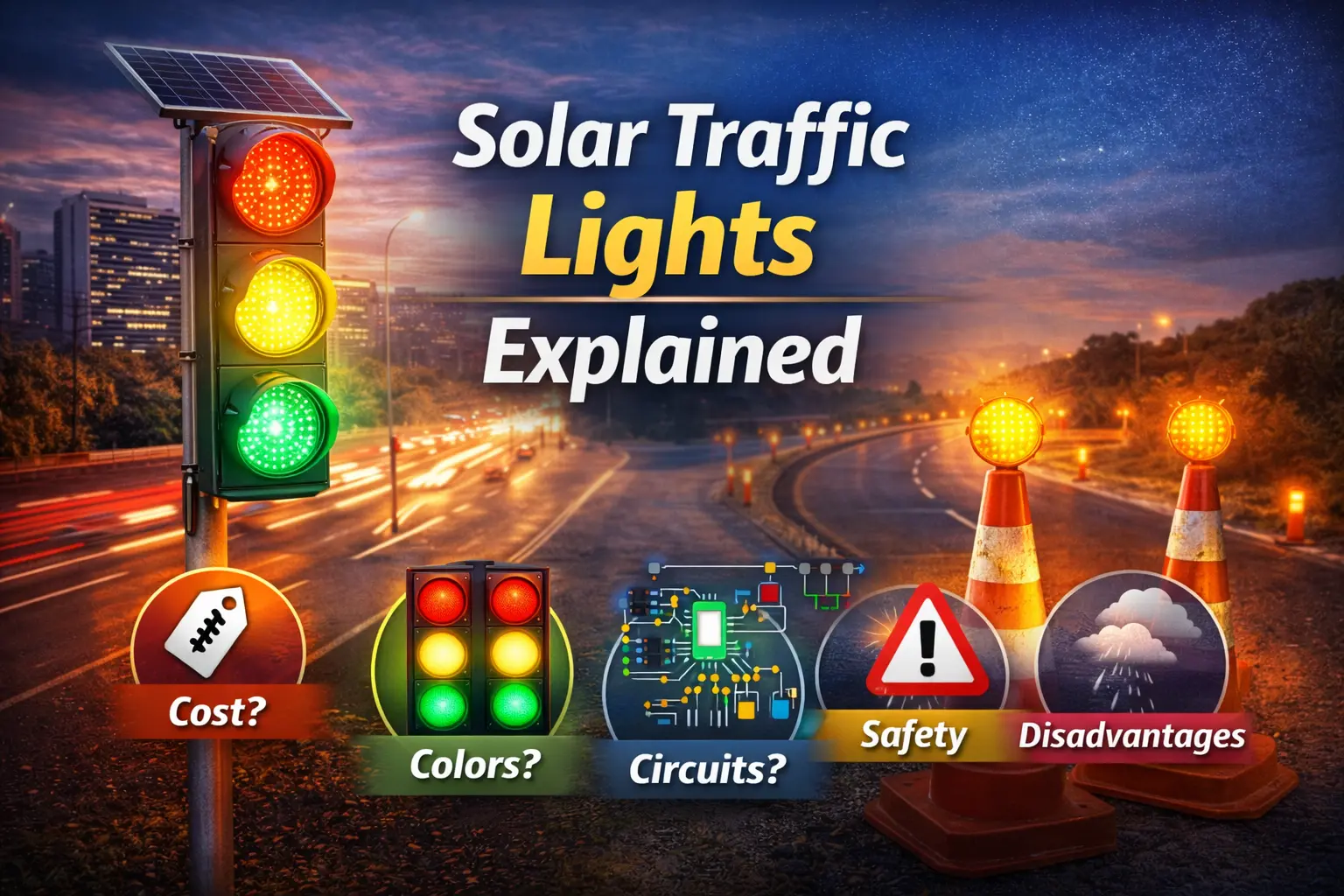
Traffic signals are among the most trusted pieces of public infrastructure. We stop without thinking, move on instinct, and trust that the system will work even during power cuts, storms, or remote road works. This is exactly where solar traffic lights step in.
Anúncios
In this article, we will clearly explain how solar traffic lights work, their price, colors, safety logic, circuit basics, and practical limitations. Everything is written from a real-world engineering and road-safety perspective, following Google’s E-E-A-T and Helpful Content guidelines.
No hype. No fake numbers. Just facts, logic, and clarity.
What Is a Solar Traffic Light?
Anúncios
A solar traffic light is a traffic signal powered by solar energy instead of the electrical grid. It uses:
- A solar panel
- A rechargeable battery
- LED signal lights
- A controller unit
During the day, sunlight charges the battery. At night or during power outages the stored energy keeps the signal running.
These systems are widely used at:
- Remote intersections
- Highway construction zones
- Temporary diversions
- Areas with unreliable grid power
Government road agencies increasingly use them to improve safety and reduce operational costs.
Anúncios
Can Traffic Lights Be Powered by Solar?
Yes and they already are, in many parts of the world.
Solar-powered traffic signals are officially approved for use in temporary and permanent applications by road authorities in multiple countries, including India and Australia.
In India, solar traffic systems align with renewable infrastructure goals promoted by the Ministry of New and Renewable Energy (MNRE) and urban transport guidelines.
Solar works best when:
- Power cuts are frequent
- Grid extension is expensive
- Signals must run 24/7 without failure
Solar Traffic Light Price: What Does One Actually Cost?
The solar traffic light price depends on size, configuration, and application.
Typical Price Ranges (India)
- Solar traffic blinker (single color): ₹8,000 – ₹20,000
- Portable solar traffic light (2–3 aspect): ₹35,000 – ₹90,000
- Intersection-grade solar traffic signal system: ₹1.5 lakh and above
Factors That Affect Cost
- Solar panel wattage
- Battery type (Li-ion vs lead acid)
- Number of signal heads
- Automation and timer complexity
- Certification and compliance
Prices vary by manufacturer and specifications, not marketing claims.
Solar Traffic Cone Lights: Small Device, Big Safety Impact
Solar traffic cone lights are compact LED lights mounted on cones or barricades. They are commonly used at:
- Night time road work zones
- Accident sites
- Lane closures
- Emergency diversions
These lights automatically turn on at dusk and flash continuously.
Why they matter:
- Improve visibility from long distances
- Reduce rear-end collisions
- Require zero wiring
Their simplicity is their biggest strength.
What Are the 4 Color Traffic Lights?
In some regions and special applications, people refer to four color traffic lights, though standard road signals use three.
Standard Colors
- Red – Stop
- Yellow (Amber) – Prepare to stop
- Green – Go
The Fourth Color (Special Use)
- White or flashing amber – Used in:
- Pedestrian crossings
- Tram or bus priority signals
- Warning-only applications
These variations are regulated and not used randomly.
What Is the Safest Color in a Traffic Light?
From a human perception and safety standpoint, red is the safest color.
Why?
- Highest visibility to the human eye
- Universally associated with danger and stopping
- Least likely to be ignored
This is supported by traffic psychology studies referenced in road design standards worldwide, including those followed by the Indian Roads Congress.
Green promotes movement. Yellow warns. Red saves lives.
Solar Traffic Light Blinker: Where It’s Used
A solar traffic light blinker is usually a single-color flashing light, most often amber or red.
Common uses include:
- Sharp curves
- School zones
- Temporary roadblocks
- Rural intersections
Blinkers consume very little power and can run for 3–5 nights without sunlight, depending on battery capacity.
What Is a Two Phase Signal?
A two phase signal is a simplified traffic signal system where traffic alternates between two main movements.
Example:
- Phase 1: North–South traffic moves
- Phase 2: East–West traffic moves
There are no dedicated turning phases.
Two phase signals are ideal for:
- Low to medium traffic intersections
- Temporary or solar powered setups
- Rural or semi urban crossings
They reduce system complexity and energy consumption.
Solar Traffic Light Circuit Diagram (Concept Explained)
A solar traffic light circuit diagram usually includes:
- Solar panel
- Charge controller
- Battery
- Microcontroller or timer IC
- LED signal modules
The controller manages:
- Charging during daylight
- Automatic switching at night
- Signal timing sequences
For safety reasons, real traffic systems use certified controllers, not DIY circuits.
How to Make a Traffic Light Circuit (Educational Context)
For learning purposes (schools or labs), a basic traffic light circuit can be made using:
- LEDs (red, yellow, green)
- Resistors
- Timer IC (like 555) or microcontroller
- Power source
However, this is not suitable for real roads. Actual traffic lights must comply with government safety and electrical standards.
Educational circuits teach logic not road safety deployment.
What Is the 20% Rule for Solar Panels?
The 20% rule for solar panels means:
A solar system should not exceed about 120% of the actual load requirement.
In traffic systems, this prevents:
- Battery overcharging
- Unnecessary system cost
- Oversizing that adds no real benefit
Designers calculate energy usage first, then size the solar panel slightly above requirement for reliability.
What Are the Disadvantages of Solar Street Lights (and Signals)?
Solar technology is reliable but not perfect.
Key Limitations
- Higher upfront cost
- Battery replacement after 4–6 years
- Performance depends on sunlight availability
- Shading can reduce efficiency
That said, for traffic safety systems, reliability during power failure often outweighs these drawbacks.
What Is the LCM of 48 Seconds, 72 Seconds, and 108 Seconds?
This question often appears in traffic signal timing logic.
The LCM (Least Common Multiple) of:
- 48
- 72
- 108
is 432 seconds.
Why it matters:
- Helps synchronize multiple signal cycles
- Ensures predictable timing patterns
- Reduces conflict between intersecting phases
Traffic engineers rely on math more than most people realize.
What Does 🚦 Mean?
The 🚦 emoji represents a traffic light or traffic signal.
Digitally, it’s used to mean:
- Traffic rules
- Road safety
- Stop and go decisions
- Metaphor for control or timing
Simple symbol. Universal meaning.
Final Thoughts: Are Solar Traffic Lights the Future?
Solar traffic lights are not experimental anymore. They are field proven, regulation-compliant, and widely adopted for both temporary and permanent traffic control.
They shine brightest when:
- Reliability matters more than grid access
- Safety must continue during outages
- Long term operating costs need control
Like traffic itself, solar signals work best when designed logically, installed correctly, and respected by everyone.
And yes sometimes the smartest traffic controller is the sun. ☀️🚦