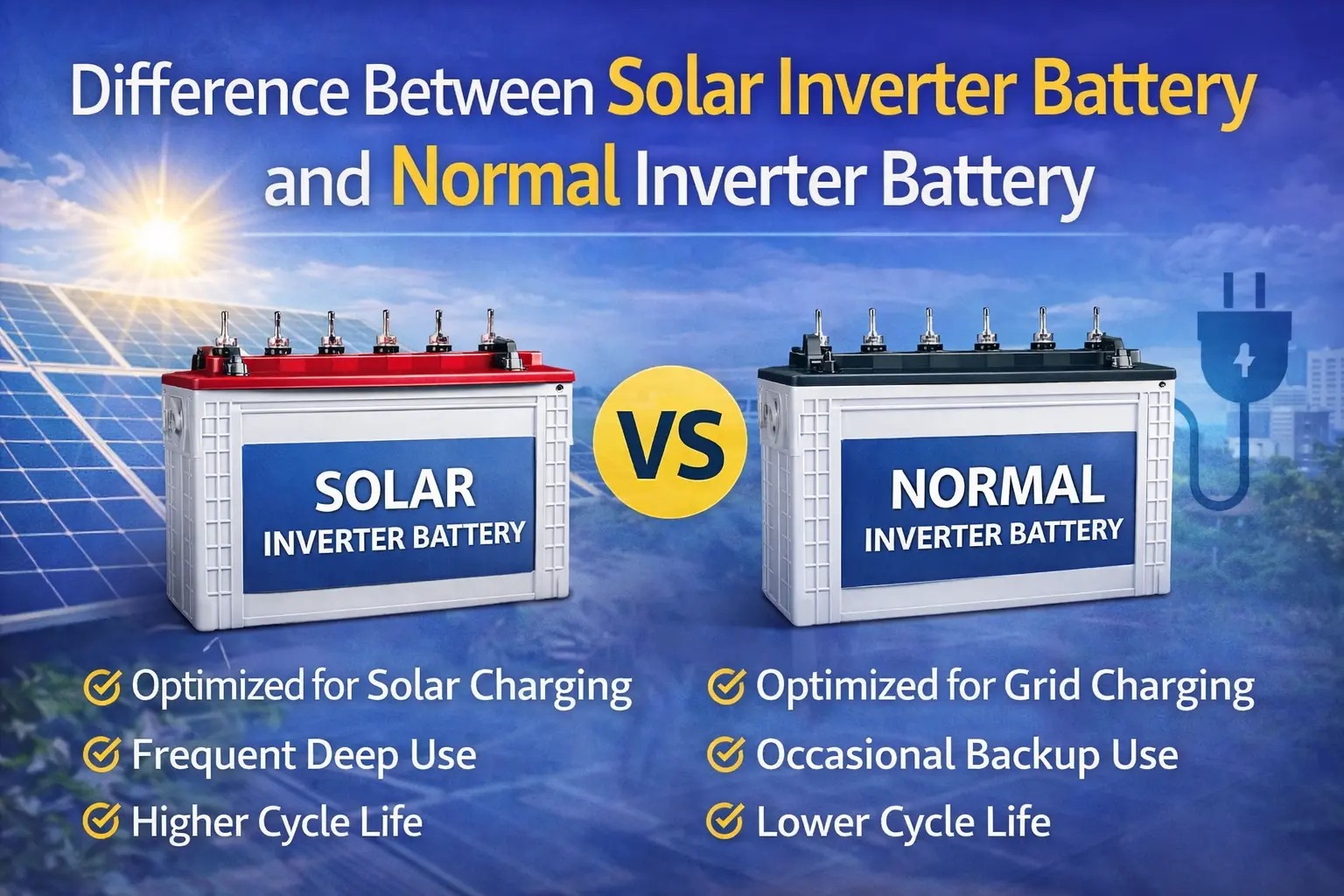
Many people think “solar inverter battery” and “normal inverter battery” are marketing terms. They are not.
Solar Inverter Battery
- Optimized for solar charging
- Supports slow, continuous input
- Designed for frequent cycling
Normal Inverter Battery
- Optimized for grid charging
- Expects fast, stable input
- Designed for fewer cycles
This difference affects lifespan, efficiency, and safety.
Charging Behavior: The Biggest Difference
Solar Battery Charging
- Slow and variable
- Depends on sunlight intensity
- May pause and resume frequently
Anúncios
Solar batteries are designed to stay stable under these conditions.
Inverter Battery Charging
- Faster and more stable
- Supplied by grid electricity
- Follows predictable charging curves
Using a normal inverter battery in solar systems often leads to:
- Incomplete charging
- Excess heat
- Reduced lifespan
Discharge Pattern: Another Key Difference
Solar Battery Discharge
- Often deep discharge
- Used daily in off-grid or hybrid systems
- Designed to handle repeated depth
Inverter Battery Discharge
- Shallow discharge most of the time
- Used mainly during outages
- Not intended for daily deep cycling
This is why inverter batteries degrade faster in solar setups.
Depth of Discharge (DoD) Comparison
Anúncios
Depth of discharge indicates how much of the battery capacity is safely usable.
Solar Battery
- Higher usable depth
- Designed to tolerate deeper discharge
Inverter Battery
- Lower safe discharge range
- Frequent deep discharge reduces life
This difference directly affects long term cost.
Plate Design Differences (Simplified)
Without getting too technical:
Solar Battery Plates
- Thicker
- Designed for slow chemical reactions
- Resist shedding over time
Inverter Battery Plates
- Thinner
- Designed for quick charge and discharge
- Wear faster under solar usage
This internal design difference explains most performance variations.
Anúncios
Cycle Life: How Long the Battery Really Lasts
Cycle life refers to how many charge-discharge cycles a battery can handle.
Solar Battery
- Built for frequent cycling
- Better suited for daily use
Inverter Battery
- Designed for limited cycles
- Best for emergency backup
Using the wrong battery type shortens usable life, even if the warranty looks similar.
Efficiency Differences
Solar Battery Efficiency
- Better energy retention during slow charge
- Handles partial charging more effectively
Inverter Battery Efficiency
- Performs best with full charge cycles
- Loses efficiency with irregular charging
Solar systems rarely provide perfect charging conditions every day.
Compatibility With Solar Charge Controllers
Solar systems rely on charge controllers to manage energy flow.
Solar Battery
- Fully compatible with MPPT and PWM controllers
- Handles variable voltage and current
Inverter Battery
- Works, but not optimally
- Higher stress under fluctuating input
This mismatch leads to heat buildup and faster aging.
Difference Between Solar and Inverter Battery in Daily Use
Let’s look at practical scenarios.
Case 1: Home With Solar Panels
- Power used during the day
- Battery charged gradually
- Night usage common
👉 Solar battery performs better here.
Case 2: Home Without Solar
- Battery charged by grid
- Used only during outages
👉 Inverter battery is sufficient here.
Can You Use Inverter Battery for Solar?
This is one of the most asked questions.
Short Answer
Yes, but it is not ideal.
What Happens in Reality
- Battery works initially
- Performance drops faster
- Replacement needed sooner
Many people do this to save money upfront but pay more later.
Can You Use Solar Battery for Normal Inverter?
Yes.
Solar batteries generally work well with normal inverters because they are more robust.
The opposite is where problems begin.
Maintenance Differences
Solar Battery Maintenance
- Designed for longer intervals
- Better tolerance to irregular charging
Inverter Battery Maintenance
- Requires consistent charging
- Sensitive to under charging
Solar conditions make consistent charging difficult.
Cost Difference: Short-Term vs Long-Term
Upfront Cost
- Solar battery usually costs more
- Inverter battery appears cheaper
Long-Term Cost
- Solar battery lasts longer in solar use
- Inverter battery replacement adds cost
True cost must include lifespan, not just purchase price.
Performance in Off-Grid Systems
Off grid systems depend heavily on battery reliability.
Solar Battery
- Stable under daily cycling
- Better suited for energy independence
Inverter Battery
- Struggles with daily deep use
- Leads to frequent failures
Off-grid setups should always use solar-rated batteries.
Hybrid Systems: Which Battery Works Best?
Hybrid systems use both grid and solar.
Solar batteries still perform better because:
- They adapt to mixed charging
- They handle variable input safely
Normal inverter batteries often become the weak point.
Safety Considerations
Improper battery use increases risk.
Solar Battery
- Designed to manage slow charging heat
- Better thermal stability
Inverter Battery
- Can overheat under prolonged solar charging
- Requires closer monitoring
Safety guidelines from energy authorities emphasize correct battery selection.
Warranty Differences (Important but Often Ignored)
Battery warranties usually depend on usage conditions.
Using an inverter battery in solar systems may:
- Void warranty
- Reduce claim acceptance
Always check usage compatibility in warranty terms.
Environmental Impact
Longer lasting batteries reduce:
- Manufacturing demand
- Disposal frequency
Solar batteries generally offer:
- Better lifecycle efficiency
- Lower replacement waste
Difference Between Inverter Battery and Solar Battery (Quick Table Explanation)
Instead of a table, here’s a quick summary in words:
- Solar battery = daily use, slow charging, deep discharge
- Inverter battery = backup use, fast charging, shallow discharge
That single contrast explains everything else.
Common Myths (Cleared)
Myth 1: All Tubular Batteries Are Same
Reality: Tubular shape does not define usage design.
Myth 2: Solar Is Just Marketing
Reality: Solar-rated batteries are engineered differently.
Myth 3: Capacity Is All That Matters
Reality: Usage pattern matters more than capacity.
Government and Technical Guidance
Renewable energy guidelines emphasize:
- Matching battery type to system type
- Avoiding misuse to ensure safety and performance
This approach appears in documents from energy authorities like MNRE, which focus on system compatibility rather than brand claims.
How to Choose the Right Battery (Simple Checklist)
Choose solar battery if:
- You use solar panels
- You need daily cycling
- You plan long-term usage
Choose inverter battery if:
- You only need backup
- You rely on grid charging
- Power cuts are occasional
What Sellers Rarely Tell You
Many sellers push inverter batteries for solar because:
- Lower cost
- Higher margins
- Faster sales
But performance reality appears after months, not days.
Future Trends in Battery Usage
Energy storage is evolving:
- Higher cycle batteries
- Better solar compatibility
- Longer service life
The difference between solar battery and inverter battery will become even more important over time.
Final Clear Answers (User Recap)
- Difference between solar battery and inverter battery:
→ Solar battery handles daily deep use; inverter battery handles backup. - Difference between inverter battery and solar battery:
→ Charging pattern and cycle life differ. - Difference between solar inverter battery and normal inverter battery:
→ Solar inverter batteries are optimized for solar input. - Difference between solar and inverter battery:
→ Design matches usage, not appearance.
Final Thought
Choosing the right battery is not about brand, color, or price tag. It is about matching design to reality. Solar power changes how batteries live and work. A battery that survives one system may fail in another.
Understand the difference. Choose wisely. Your system and your wallet will thank you.