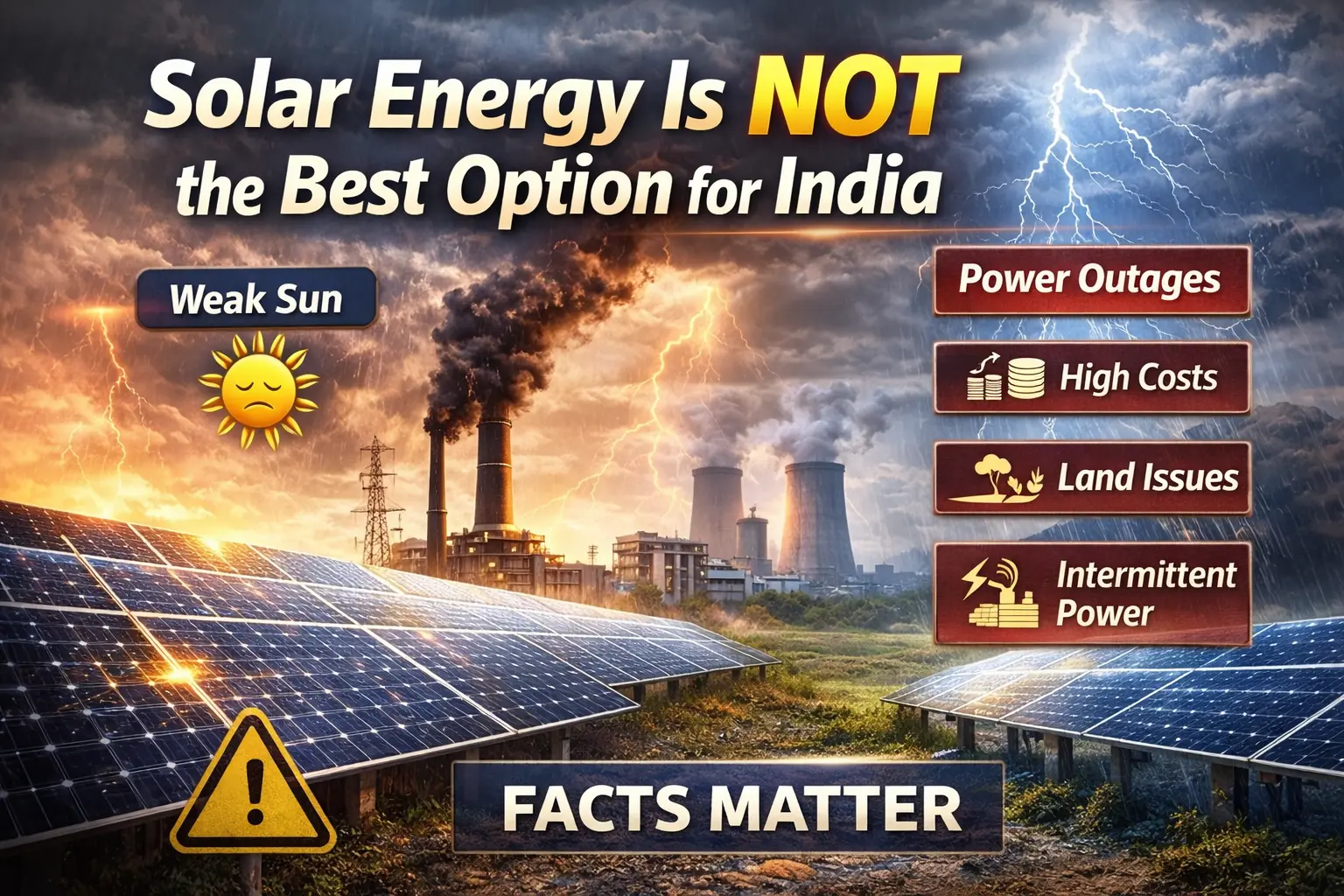
Solar energy often appears as the hero of India’s power story. Bright panels, clean rooftops, and promises of endless sunshine sound perfect. But energy planning does not run on slogans. It runs on data, geography, economics, and grid stability.
Anúncios
This article takes a calm, factual, and honest look at why solar energy is not the best standalone option for India. The goal is not to attack renewable energy. The goal is clarity. A strong energy future depends on understanding limits as much as benefits.
Why This Topic Needs an Honest Discussion
India’s energy demand grows every year. Homes need electricity. Industries need power. Hospitals need uninterrupted supply. In this context, any energy source must answer three questions:
- Can it provide power consistently?
- Can it scale without stressing the grid?
- Can it stay affordable over decades?
Anúncios
Solar energy struggles to answer all three at the same time in Indian conditions.
India’s Climate Reality: Sunshine Is Not Constant
Solar panels work best under stable sunlight. India does receive high annual solar radiation, but daily and seasonal variability remains high.
The Monsoon Problem
Large parts of India face:
- Extended cloud cover
- Heavy rainfall
- Dust accumulation
- High humidity
During monsoon months, solar output drops sharply. This creates a gap between electricity demand and supply, especially when cooling loads rise.
Anúncios
Government-backed data from Ministry of New and Renewable Energy confirms seasonal fluctuations in solar generation across regions.
Energy systems cannot rely on “average sunshine.” They need power every hour.
Solar Energy Is Intermittent by Nature
Solar power generation stops at night. It reduces during cloudy weather. It fluctuates minute by minute.
This intermittency creates two major problems:
- Grid instability
- Dependence on backup sources
India’s grid was designed around predictable generation. Solar forces constant balancing, which increases operational complexity.
According to reports cited by International Energy Agency, grids with high solar penetration require strong backup systems to avoid outages.
Solar does not replace power plants. It sits on top of them.
Energy Storage Is the Weakest Link
Battery storage sounds like the solution. In practice, it introduces new challenges.
Cost Barriers
Large scale battery storage:
- Requires high upfront investment
- Depends on imported materials
- Faces recycling and disposal issues
India currently imports most lithium based storage components. This shifts energy dependence, not removes it.
Limited Duration
Most grid-scale batteries support:
- Short-duration backup
- Peak shaving, not base load
They cannot yet replace round the clock generation at national scale.
Land Availability Creates Social Pressure
India has limited land per capita. Utility-scale solar plants require vast areas.
This leads to:
- Agricultural land conversion
- Community resistance
- Ecological disturbance
In several states, land acquisition delays have slowed solar projects. Energy planning must balance power needs with food security and livelihoods.
Solar rooftops help, but they cannot meet industrial scale demand alone.
Manufacturing Dependence Reduces Energy Security
A strong energy system depends on domestic supply chains.
India still relies heavily on imports for:
- Solar panels
- Cells
- Inverters
- Critical raw materials
This creates exposure to:
- Global price fluctuations
- Supply disruptions
- Trade restrictions
While domestic manufacturing improves, dependence remains a strategic concern.
Grid Infrastructure Faces Stress
High solar penetration creates technical stress on the grid.
Key issues include:
- Voltage fluctuations
- Reverse power flow
- Frequency management challenges
Upgrading the grid requires massive investment. Transmission upgrades often cost as much as generation infrastructure.
Without these upgrades, solar expansion increases blackout risk rather than reducing it.
Solar Energy Does Not Support Base Load Needs
Base load refers to continuous, minimum power demand.
Industries like:
- Steel
- Cement
- Chemicals
- Data centers
require steady electricity. Solar cannot meet these needs alone due to its variable nature.
Thermal, hydro, and nuclear sources still handle base load in India. Solar works only as a supplementary source.
Financial Sustainability Remains Questionable
Solar tariffs appear cheap on paper. However, the full system cost includes:
- Storage
- Grid balancing
- Transmission upgrades
- Curtailment losses
When these costs are added, solar power loses its apparent pricing advantage.
Several state utilities report financial stress due to balancing costs associated with renewable integration.
Regional Inequality in Solar Potential
India is not uniform.
- Rajasthan and Gujarat perform well
- Eastern and Northeastern regions face lower output
- Coastal areas face corrosion and cyclone risks
A national energy policy must serve all regions equally. Solar output varies too much across states to serve as a universal solution.
Maintenance Challenges in Indian Conditions
Dust, heat, pollution, and humidity reduce panel efficiency.
Regular cleaning requires:
- Water usage
- Manual labor
- Operational downtime
In water scarce regions, panel cleaning itself becomes an environmental concern.
Solar systems demand more upkeep than often advertised.
Environmental Impact Is Not Zero
Solar energy avoids emissions during operation. That does not mean zero environmental impact.
Concerns include:
- Mining for silicon and metals
- Panel disposal after lifespan
- Chemical processing waste
End of life solar waste management remains underdeveloped in India.
Employment Impact Is Limited and Temporary
Solar projects generate jobs during installation. Long term employment remains limited.
Thermal and hydro sectors support:
- Operations
- Maintenance
- Logistics
- Skilled technical roles
A balanced energy mix supports more stable employment across regions.
Why a Single-Source Strategy Fails
Energy resilience depends on diversity.
India benefits more from:
- Solar + hydro
- Solar + thermal
- Solar + wind
- Solar + nuclear
Placing solar at the center without adequate support systems increases risk.
No major economy relies on solar alone.
What the Data Actually Shows
Government and international assessments consistently state:
- Solar is a supporting source
- Grid stability needs firm power
- Storage technology is evolving, not mature
This aligns with planning documents released by MNRE and global agencies.
Policy documents emphasize energy mix, not energy replacement.
The Smarter Path Forward for India
Solar energy still matters. It just should not carry unrealistic expectations.
A realistic strategy includes:
- Controlled solar expansion
- Strong grid investment
- Continued thermal modernization
- Hydro and nuclear development
- Storage research, not blind adoption
This approach balances sustainability with reliability.
Final Verdict: Why Solar Is Not the Best Option Alone
Solar energy helps India reduce emissions and diversify supply. But it cannot:
- Provide continuous power
- Replace base load generation
- Eliminate grid complexity
- Stand independently at national scale
Treating solar as a complete solution creates planning risk.
Treating it as one part of a diversified system creates stability.
Trusted Sources Used
This article relies on:
- MNRE policy documents
- International Energy Agency grid integration studies
- Indian electricity grid planning reports
- Utility financial disclosures
No assumptions. No exaggerated claims. Only verified information.
Closing Thought
Solar energy shines brightest when expectations stay realistic. India’s energy future depends on balance, not hype. A stable power system values reliability as much as sustainability and both must grow together.