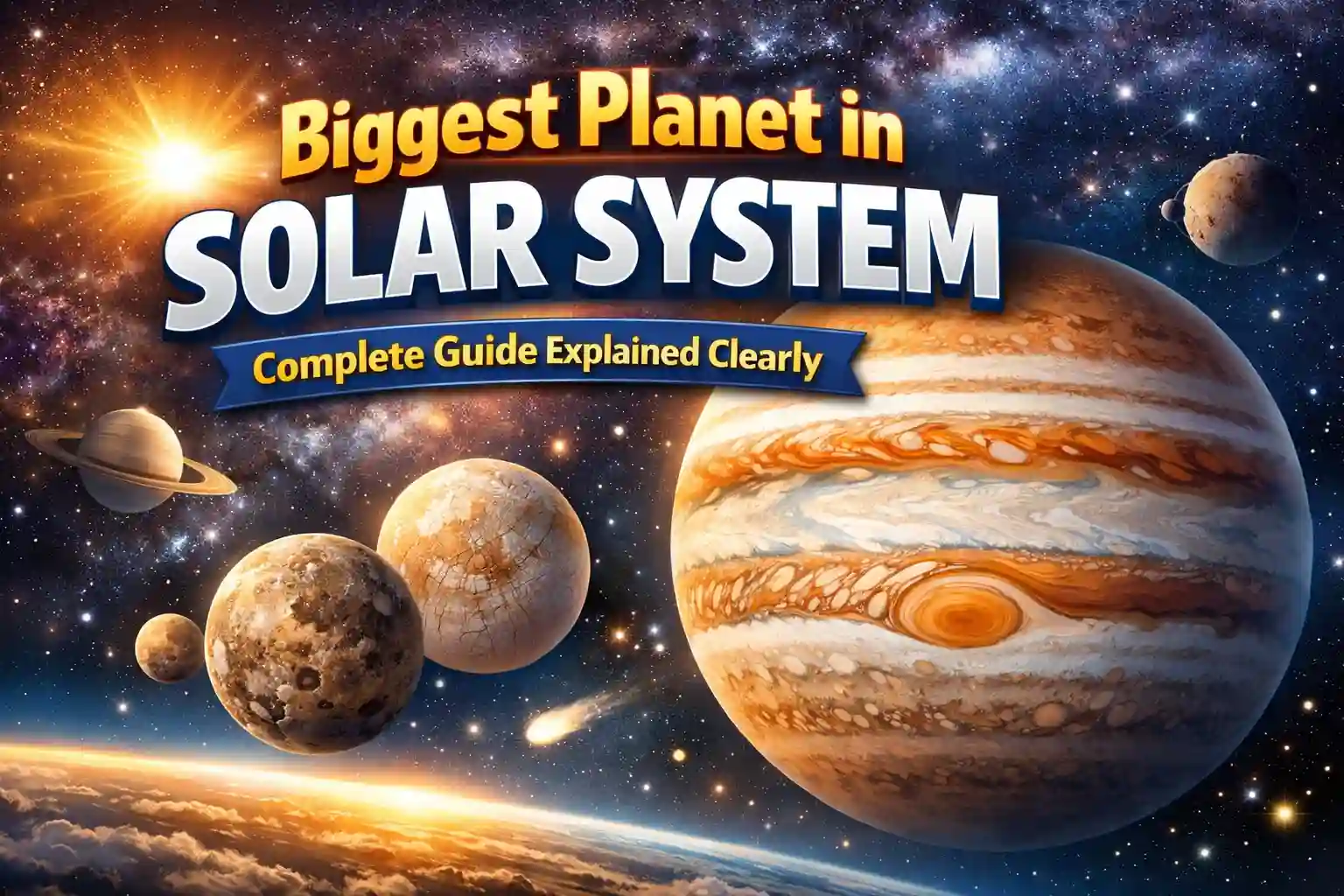
When people ask which is the biggest planet in our solar system? the answer is simple Jupiter. But that short answer does not tell the full story.
Anúncios
The biggest planet in the solar system is not just slightly larger than the others. It is enormous. In fact, Jupiter is so large that all the other planets combined would still not match its mass. That is not exaggeration. It is based on astronomical measurements confirmed by space missions and observational science.
In this detailed guide, we will explain:
- Which is the biggest planet in the solar system
- Why Jupiter is so large
- How it compares to the second biggest planet in solar system
- Key scientific facts supported by verified sources
We will keep everything clear, accurate, and easy to understand.
Which Is the Biggest Planet in Our Solar System?
The biggest planet in our solar system is Jupiter.
Jupiter is classified as a gas giant. It is primarily made of hydrogen and helium, similar to the Sun. According to data from NASA, Jupiter has:
- A diameter of about 143,000 kilometers
- More than twice the mass of all other planets combined
- A strong magnetic field
- Dozens of moons
NASA’s planetary data confirms Jupiter’s position as the largest planet in our solar system.
Anúncios
Why Is Jupiter the Biggest Planet in the Solar System?
To understand why Jupiter became so large, we need to look at how the solar system formed.
Scientists believe the solar system formed around 4.6 billion years ago from a cloud of gas and dust. Jupiter formed early in this process. Because of its strong gravity, it attracted large amounts of surrounding gas before the solar wind from the young Sun pushed remaining gas away.
This early formation allowed Jupiter to gather massive amounts of hydrogen and helium. That is why it became the biggest planet in solar system history.
How Big Is Jupiter Compared to Earth?
Numbers make this clearer.
- Jupiter’s diameter is more than 11 times that of Earth.
- Its volume is large enough to hold over 1,300 Earths.
- Its mass is about 318 times the mass of Earth.
Even though it is massive, Jupiter is less dense than Earth because it is mostly gas.
These figures come from measurements published by NASA and international planetary research institutions.
What Makes Jupiter Unique?
Jupiter is not just big. It is extreme in many ways.
1. The Great Red Spot
Jupiter has a giant storm called the Great Red Spot. It has existed for more than 300 years and is large enough to swallow Earth.
Spacecraft such as NASA’s Juno mission have studied this storm in detail.
2. Fast Rotation
Jupiter rotates very quickly. One day on Jupiter lasts about 10 hours. This fast spin causes the planet to bulge at the equator.
3. Strong Magnetic Field
Jupiter has the strongest magnetic field of any planet in the solar system. This field traps radiation and creates powerful auroras near its poles.
Which Is the Second Biggest Planet in Solar System?
The second biggest planet in solar system is Saturn.
Saturn is also a gas giant and shares similarities with Jupiter. However, it is smaller in both mass and diameter.
According to planetary data:
- Saturn’s diameter is about 120,500 kilometers
- Saturn’s mass is much lower than Jupiter’s
- Saturn is less dense than water
Despite being second biggest planet in solar system rankings, Saturn still holds a special place due to its iconic ring system.
Jupiter vs Saturn: A Simple Comparison
When comparing the biggest planet in our solar system with the second biggest, the differences become clear.
| Feature | Jupiter | Saturn |
|---|---|---|
| Rank | Biggest planet | Second biggest planet |
| Diameter | Larger | Smaller |
| Mass | Much heavier | Less heavy |
| Rings | Thin rings | Prominent ring system |
Both are gas giants, but Jupiter clearly dominates in size and mass.
Why Isn’t the Sun Considered the Biggest Planet?
This question sometimes comes up.
The Sun is not a planet. It is a star. While it is far larger than Jupiter, it belongs to a different category. Planets orbit stars, and the Sun sits at the center of the solar system.
So when asking “which is the biggest planet in the solar system?” we are only comparing planets, not stars.
What Are Gas Giants?
Jupiter and Saturn belong to a category called gas giants.
Gas giants:
- Are mostly hydrogen and helium
- Do not have solid surfaces like Earth
- Have thick atmospheres
- Often have ring systems
The outer solar system contains these massive planets, while smaller rocky planets orbit closer to the Sun.
Could There Be a Bigger Planet Than Jupiter?
Within our solar system, no planet is bigger than Jupiter.
However, astronomers have discovered planets outside our solar system, called exoplanets, that are larger than Jupiter. These are not part of our solar system.
Within our system, Jupiter remains the biggest planet.
How Scientists Measure Planet Size
Astronomers measure planets using:
- Telescopes
- Spacecraft missions
- Orbital calculations
- Radar measurements
NASA’s Juno spacecraft has provided detailed measurements of Jupiter’s gravity, magnetic field, and structure.
These data confirm Jupiter’s rank as the biggest planet in solar system records.
Does Size Mean Stronger Gravity?
Generally, yes.
Jupiter’s massive size gives it strong gravity. This gravity:
- Influences nearby asteroids
- Helps protect inner planets from some space debris
- Maintains its many moons in orbit
Jupiter has over 90 known moons, according to current astronomical data.
How Many Moons Does the Biggest Planet Have?
Jupiter has more moons than any other planet in our solar system.
Some of its largest moons include:
- Io
- Europa
- Ganymede
- Callisto
Ganymede is the largest moon in the solar system and is even bigger than Mercury.
These discoveries come from decades of space exploration missions.
Could Jupiter Become a Star?
This is a popular myth.
Although Jupiter is made mostly of hydrogen like the Sun, it does not have enough mass to start nuclear fusion. Scientists estimate it would need many times its current mass to ignite like a star.
So Jupiter will remain the biggest planet in our solar system, not a star.
Why Jupiter Matters in Solar System Stability
Jupiter’s gravity plays a major role in shaping the solar system.
Its strong gravitational pull:
- Influences asteroid belts
- Alters comet paths
- Affects planetary orbits
Some scientists suggest Jupiter may have reduced the number of large impacts on inner planets.
Quick Answers to Common Questions
Which is the biggest planet in our solar system?
Jupiter.
Which is the biggest planet in the solar system?
Jupiter.
Biggest planet in our solar system?
Jupiter remains the largest by mass and diameter.
Second biggest planet in solar system?
Saturn.
Why Jupiter Is So Fascinating
Beyond being the biggest planet in solar system measurements, Jupiter is fascinating because:
- It formed early in planetary history
- It influenced solar system structure
- It continues to provide insights into planetary science
Space missions continue to study it for answers about planetary formation.
Final Thoughts
The biggest planet in solar system studies is clearly Jupiter. Its massive size, strong gravity, numerous moons, and powerful storms make it a giant in every sense.
The second biggest planet in solar system rankings, Saturn, is also enormous, but Jupiter stands unmatched in mass and overall scale.