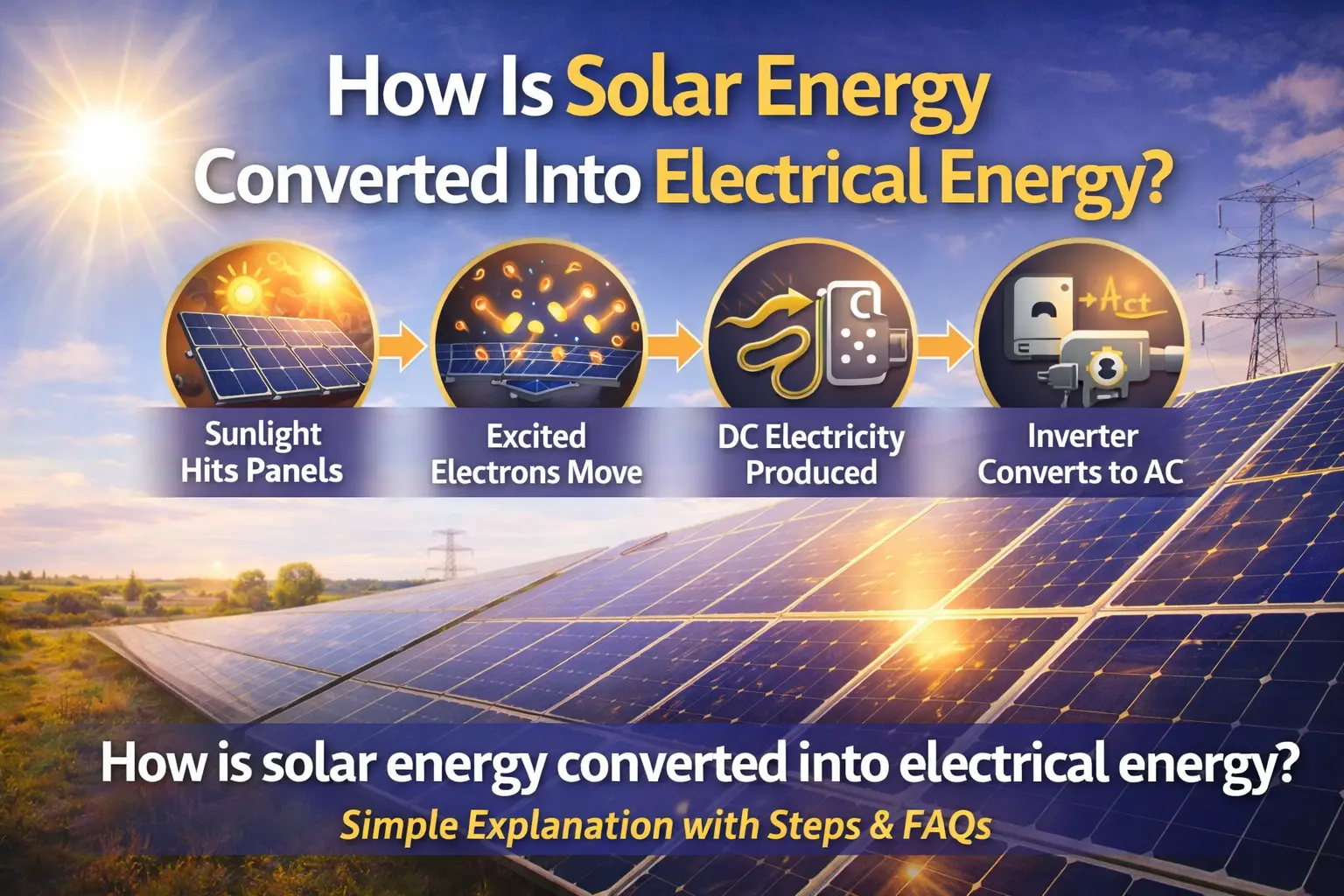
Imagine a giant, silent nuclear reactor floating 93 million miles away in space, beaming enough energy to our planet in a single hour to power the entire human race for an entire year. That reactor is our sun. But sunlight is just light it isn’t electricity until we “catch” it and translate it into a language our appliances understand.
If you’ve ever looked at a shimmering blue solar panel on a neighbor’s roof and wondered, How is solar energy converted into electrical energy? you aren’t alone. It feels like high tech magic, but it is actually a beautiful, elegant dance of physics known as the photovoltaic effect.
Anúncios
In this comprehensive guide, we will break down the how is solar energy converted into electricity principle, explore the hardware that makes it happen, and look at why this technology is the backbone of the global energy transition in 2026.
The Core Concept: The “Photovoltaic” Secret
To truly understand the how is solar energy converted into electricity principal, we have to look at the word “Photovoltaic” (PV). It is a marriage of two Greek and Latin roots: “photo,” meaning light, and “voltaic,” referring to electricity (named after Alessandro Volta).
Unlike traditional power plants, solar energy conversion doesn’t require burning fuel, boiling water, or spinning giant turbines. Instead, it utilizes the unique properties of semiconductors materials like silicon that can sit somewhere between being a metal (conductor) and an insulator.
How Sunlight “Knocks” Electrons Loose
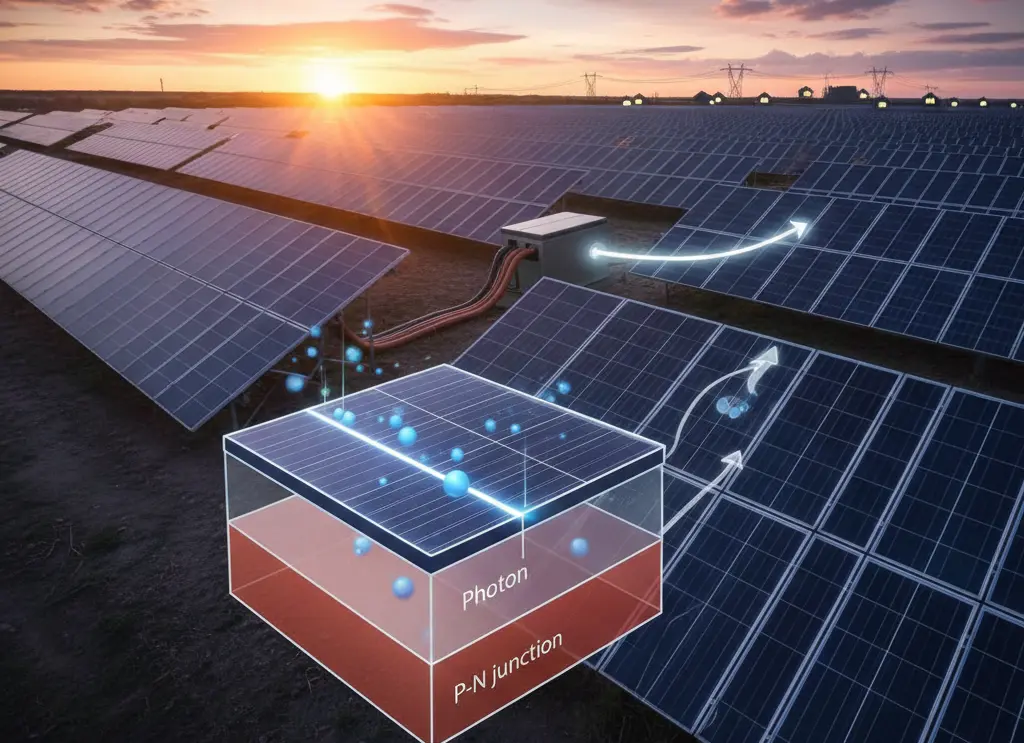
Sunlight is composed of tiny, discrete packets of energy called photons. These photons travel from the sun at the speed of light. When they strike a solar cell, they transfer their energy to the electrons sitting inside the silicon atoms.
Anúncios
Think of it like a cosmic game of billiards: the photon is the cue ball, and the electron is the target ball. When the photon hits the electron with enough force, it knocks the electron out of its comfortable “home” in the atom. Once these electrons are loose, they are free to move. However, random movement doesn’t give us power. We need them to move in a specific direction and that is where the “principle” of the solar cell design comes into play.
The Anatomy of a Solar Cell: Creating a “One Way Street”
Simply knocking electrons loose isn’t enough; you need to create a pathway for them to flow. This is where the how solar energy is converted into electrical by voltaic process gets clever.
A solar cell isn’t just a slab of silicon. It is a “sandwich” of two different layers that have been chemically altered through a process called doping.
- N-Type Silicon (Negative): The top layer is “doped” with an element like phosphorus, which has more electrons than silicon. This gives the layer a surplus of negative charge.
- P-Type Silicon (Positive): The bottom layer is doped with boron, which has fewer electrons, creating “holes” or positive charges.
When these two layers are joined, a unique phenomenon occurs at the boundary the P N Junction. An internal electric field forms here, acting like a one way street or a slide. It pushes the newly freed electrons toward the N type side and the “holes” toward the P type side. This organized movement of charge is exactly what we call electric current.
The Step by Step Conversion Process
While the science happens at the atomic level, the practical application involves a sophisticated chain of hardware. Here is the journey of a photon from the sun to your toaster.
1. Absorption and Excitation
The process begins the moment photons hit the surface of the PV cell. The cell is covered with an anti-reflective coating to ensure as many photons as possible are absorbed rather than bouncing off like a mirror.
2. Charge Separation
As the photons dislodge electrons, the internal electric field at the P N junction sorts them. Electrons are pulled to the top of the cell, where thin metallic “fingers” (those grid lines you see on panels) collect them.
3. Direct Current (DC) Generation
As the electrons flow through the metallic contacts and into a wire, they create Direct Current (DC). This is the same type of electricity found in a battery or your car’s electrical system.
4. The Inverter: The “Translator”
Here is the catch: almost everything in your home your fridge, TV, and lights runs on Alternating Current (AC). Additionally, the utility grid operates on AC.
To solve this, the DC electricity from the panels travels to a device called an inverter. The inverter “flips” the current back and forth (60 times per second in the US, 50 in many other regions) to create usable AC power.
5. Distribution and Net Metering
Once converted to AC, the electricity flows to your home’s main breaker box. If your panels are producing more power than you are using which happens often on bright afternoons the excess electricity flows backward through your meter and into the utility grid. In many places, “Net Metering” allows you to get credit for this contribution, effectively using the grid as a giant battery.
The Hardware: Cells, Panels, and Arrays
When people ask how is solar energy converted into electrical energy, they are usually looking at a “Solar Panel,” but that panel is part of a hierarchy:
- Solar Cell: The small, square building block (the “battery” of the system).
- Solar Panel (Module): A collection of roughly 60 to 72 cells wired together and sealed behind protective glass.
- Solar Array: A group of panels wired together to provide the total power needed for a building or a power plant.
Types of Panels in 2026
Not all solar panels are created equal. Depending on the material, their efficiency varies:
- Monocrystalline: Made from a single, pure silicon crystal. These are the sleek, black panels you see on modern roofs. They are highly efficient (20-24%) but usually more expensive.
- Polycrystalline: Made by melting many silicon fragments together. They have a blue, speckled look and are slightly less efficient (15-20%) but more budget friendly.
- Thin Film: A newer generation where the PV material is “sprayed” or deposited onto a surface like glass or metal. These are flexible and lightweight but generally less efficient.
Why Efficiency Matters: The Shockley Queisser Limit
You might wonder: If sunlight is free, why aren’t panels 100% efficient? Physics has a speed limit called the Shockley Queisser Limit. It explains that a standard single junction silicon cell can only ever reach about 33.7% efficiency. The rest of the energy is lost as heat or because the photons simply don’t have enough “kick” to dislodge an electron.
However, in 2026, we are breaking these limits using Tandem Cells. By layering silicon with a new material called Perovskite, engineers are creating panels that “catch” different colors of the light spectrum, pushing efficiencies toward 30% and beyond.
The Real Economics: Scaling Up
If you are looking at this from a large-scale perspective perhaps researching 1 Megawatt (MW) solar power plant costs in India or the US the math changes.
A 1 MW plant is roughly enough to power 700 to 1,000 homes. In 2026, the cost of solar has dropped so significantly that it is often the cheapest form of new electricity generation on the planet. The “Balance of System” (land, labor, inverters, and racking) now costs more than the panels themselves.
| Factor | Impact on Conversion |
| Angle & Tilt | Panels must be angled to face the sun directly to maximize photon absorption. |
| Temperature | Paradoxically, panels lose efficiency as they get very hot. Airflow is key! |
| Shading | Even a small shadow from a tree can “clog” the flow of electrons in a whole string of panels. |
Beyond the Roof: The Environmental Impact
The beauty of the how is solar energy converted into electricity principle is its cleanliness. Traditional coal or gas plants use vast amounts of water for cooling and emit CO2 during combustion.
Solar energy:
- Uses zero water during operation (unlike steam driven plants).
- Produces zero emissions at the point of generation.
- Has a “Carbon Payback” of about 1 to 2 years meaning the panel produces more clean energy than it took to manufacture it in a very short time.
Conclusion: A Sun Powered Future
Understanding how is solar energy converted into electrical energy reveals that we aren’t just using a “product” we are participating in a fundamental shift in how humanity interacts with the planet. By harnessing the photovoltaic effect, we have found a way to turn the most abundant resource in our solar system into the power that drives our digital lives, our homes, and our vehicles.
As technology continues to evolve with smarter inverters, better batteries, and high efficiency tandem cells the question isn’t whether solar will power the world, but how quickly we can make the switch.