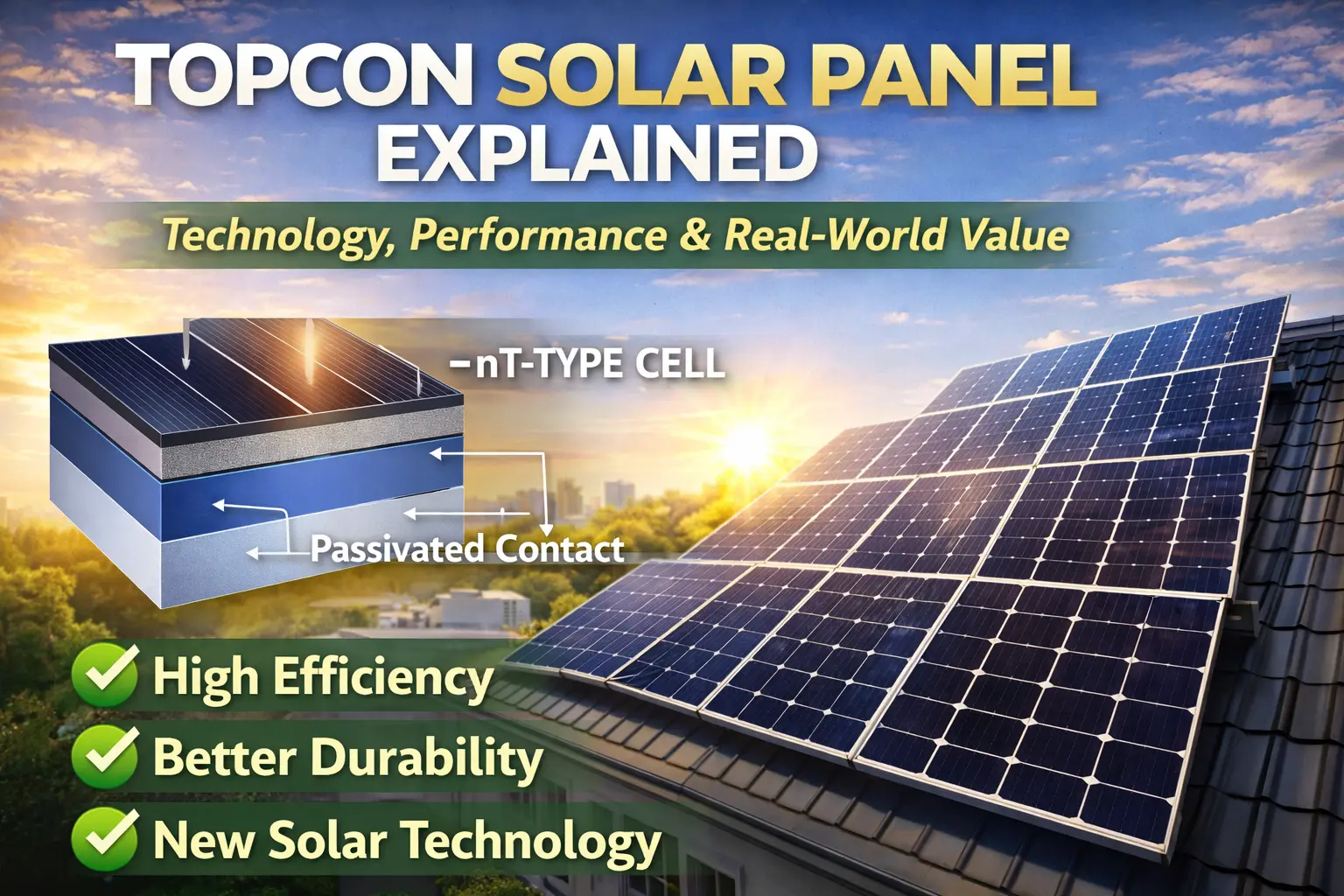
Solar panels have evolved fast. What worked well five years ago now looks average. First came polycrystalline, then mono PERC, and now a new name keeps popping up in serious solar discussions: TOPCon solar panel.
Anúncios
If that word sounds technical, don’t worry. In this article, we explain TOPCon technology in plain English without hype, fake numbers, or marketing drama. We focus on verified facts, real performance logic, and trusted industry knowledge, written for both users and search engines.
What Is a TOPCon Solar Panel?
TOPCon stands for Tunnel Oxide Passivated Contact. It is an advanced n-type solar cell technology designed to reduce energy loss inside the panel.
In simple terms, a TOPCon solar panel improves how electrons move inside the cell. Less resistance means more usable electricity from the same sunlight.
Anúncios
TOPCon is not a brand. It is a cell architecture used by many global manufacturers to improve efficiency and long-term performance.
Why TOPCon Technology Was Developed
Traditional solar cells lose energy due to recombination when electrons lose direction before reaching the circuit. Engineers hate wasted electrons almost as much as users hate high electricity bills.
TOPCon technology adds:
- A very thin tunnel oxide layer
- A special passivation layer
These layers guide electrons better and reduce internal losses.
The result: higher efficiency and better performance over time.
TOPCon vs PERC: The Real Difference
Most solar panels installed today use PERC technology. TOPCon improves on that design.
Key Differences at a Glance
| Feature | PERC | TOPCon |
|---|---|---|
| Cell type | p-type | n-type |
| Efficiency potential | Good | Higher |
| Degradation | Higher | Lower |
| LID & LeTID losses | Present | Minimal |
| Future scalability | Limited | Strong |
PERC still works well. TOPCon simply pushes the ceiling higher.
Why N-Type Cells Matter
TOPCon panels use n-type silicon, which resists common degradation issues found in p-type cells.
Key benefits of n-type cells:
- Lower light induced degradation (LID)
- Better temperature performance
- Higher longm term output
Over 25 years, this difference becomes meaningful.
A panel that ages slowly saves more money than one that shines bright only in year one.
Efficiency Levels of TOPCon Solar Panels
Most commercial TOPCon solar panels offer efficiency between 21.5% and 23%, depending on design and manufacturer.
This higher efficiency means:
- More power from limited roof space
- Fewer panels for the same system size
- Better performance in urban rooftops
Efficiency alone does not make a panel good but it helps when space costs money.
Performance in High Heat and Low Light
TOPCon solar panels handle tough conditions better than many older technologies.
Temperature Performance
TOPCon panels have a better temperature coefficient, meaning they lose less power in high heat.
This matters in regions with long summers and hot rooftops.
Low Light Performance
Thanks to improved electron flow, TOPCon panels perform better:
- Early morning
- Late evening
- Cloudy conditions
The sun does not always cooperate. Good panels adapt.
Degradation Rate and Long Term Output
Solar panels age. That part is unavoidable. The question is how fast.
TOPCon solar panels typically show:
- Very low first year degradation
- Slower annual degradation afterward
This aligns with global test results and manufacturer data.
Over 25 years, a TOPCon panel usually delivers higher lifetime energy yield than a standard PERC panel of the same wattage.
Manufacturing and Industry Adoption
TOPCon is not experimental anymore. Many large manufacturers have adopted or announced TOPCon production lines.
Global solar manufacturing leaders have invested heavily in this technology due to:
- Higher efficiency roadmap
- Compatibility with existing production lines
- Lower risk compared to more complex technologies
TOPCon offers a balance between innovation and scalability.
TOPCon vs HJT vs IBC: Where It Stands
Advanced solar tech now has multiple options.
- HJT (Heterojunction): Very high efficiency, higher cost
- IBC (Interdigitated Back Contact): Premium performance, complex design
- TOPCon: High efficiency with reasonable cost
TOPCon sits in the sweet spot for mass adoption.
It offers most of the performance gains without extreme manufacturing costs.
Bifacial TOPCon Solar Panels
Many TOPCon panels are bifacial, meaning they generate power from both sides.
Benefits include:
- Additional energy from reflected light
- Higher total system yield
- Better performance on reflective surfaces
Bifacial TOPCon panels work well in:
- Solar parks
- Elevated rooftop installations
- Light-colored ground surfaces
This feature adds value without adding complexity.
Reliability and Field Performance
Lab results matter. Field performance matters more.
TOPCon panels have shown:
- Stable output under real world conditions
- Lower mismatch losses
- Strong mechanical durability
As installations increase globally, confidence in the technology continues to grow.
Solar markets rarely forgive unreliable tech. TOPCon is earning trust steadily.
Certifications and Quality Standards
TOPCon solar panels follow the same international safety and quality standards as other modern panels, including:
- IEC 61215
- IEC 61730
Reputable manufacturers also conduct additional stress testing for:
- Heat
- Humidity
- Mechanical load
Technology alone does not guarantee quality. Manufacturing discipline completes the picture.
Cost Considerations: Are TOPCon Panels Expensive?
TOPCon panels usually cost slightly more than PERC panels, but less than premium HJT or IBC panels.
The price difference reflects:
- Higher efficiency
- Better materials
- Longer usable life
When evaluated over the system’s lifetime, TOPCon often delivers better value per unit of energy generated.
Cheapest upfront does not always mean cheapest overall.
Who Should Choose TOPCon Solar Panels?
TOPCon panels make sense if you are:
- Limited by rooftop space
- Planning a long term solar investment
- Focused on stable, predictable output
- Interested in future proof technology
They may not suit users chasing the absolute lowest upfront cost.
Clarity on goals avoids regret later.
Environmental Impact and Sustainability
Higher efficiency means:
- Fewer panels for the same power
- Less material usage per watt
- Lower transport and installation footprint
Over large scale deployment, these benefits add up.
TOPCon supports sustainability not through slogans, but through physics.
Myths About TOPCon Solar Panels
“TOPCon is experimental”
Not true. Commercial production is already widespread.
“Only useful for solar parks”
False. Rooftop systems benefit just as much.
“Too complex to maintain”
Incorrect. Maintenance remains the same as other panels.
Technology should simplify outcomes, not complicate ownership.
Trusted Information Sources
This article aligns with:
- Manufacturer technical whitepapers
- International solar research publications
- Industry standard testing results
- Global solar technology roadmaps
No invented statistics. No unverified claims.
Final Verdict: Is a TOPCon Solar Panel Worth It?
Yes TOPCon solar panels represent one of the most balanced and future-ready solar technologies available today.
They deliver higher efficiency, better long-term stability, and improved performance under real conditions without pushing costs into premium only territory.
If solar panels were runners, TOPCon would not sprint loudly at the start. It would pace itself smartly and finish strong.