
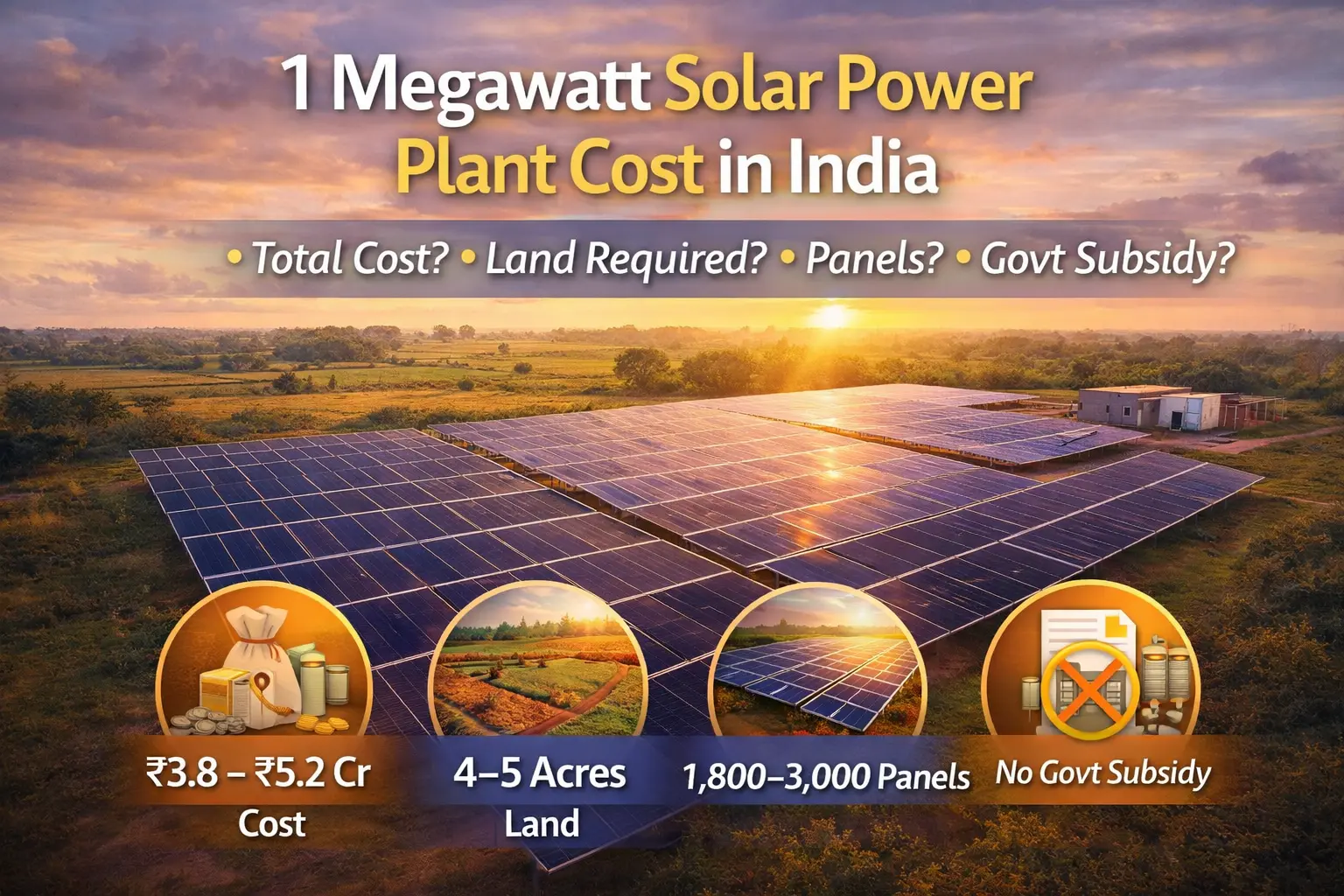
Large scale solar power is no longer limited to big corporations or government projects. Today, 1 megawatt (MW) solar power plants are being developed by private investors, farmers, industries, and EPC companies across India. Naturally, one question dominates every discussion:
Anúncios
What is the 1 megawatt solar power plant cost in India?
This guide answers that question in full detail without exaggeration or vague estimates. We will cover total project cost, land requirement, daily power generation, number of panels, government subsidy reality, and even how a 2 MW plant compares. Every explanation is grounded in real world data and policy-backed sources.
What Does a 1 Megawatt Solar Power Plant Mean?
Anúncios
A 1 MW solar power plant has a peak installed capacity of 1,000 kilowatts (1,000 kW) under standard test conditions.
In simple terms:
- It is a utility scale or commercial-scale solar installation
- It feeds electricity into the grid or captive industrial use
- It is far larger than rooftop solar systems
Unlike home solar, a 1 MW plant is treated as infrastructure, not a consumer appliance.
1 Megawatt Solar Power Plant Cost in India (2026 Reality)
The total cost of a 1 megawatt solar power plant in India depends on technology, location, land type, and EPC quality.
Anúncios
Average Cost Range (Ground Mounted)
- ₹3.8 crore to ₹5.2 crore per MW
This range reflects:
- Falling module prices
- Improved inverter efficiency
- Rising land and evacuation costs
Rooftop or Elevated Structures
- Can exceed ₹5.5 crore per MW due to civil and structural work
These figures align with benchmarks published by the Ministry of New and Renewable Energy (MNRE) and recent EPC tender data.
Source: mnre.gov.in
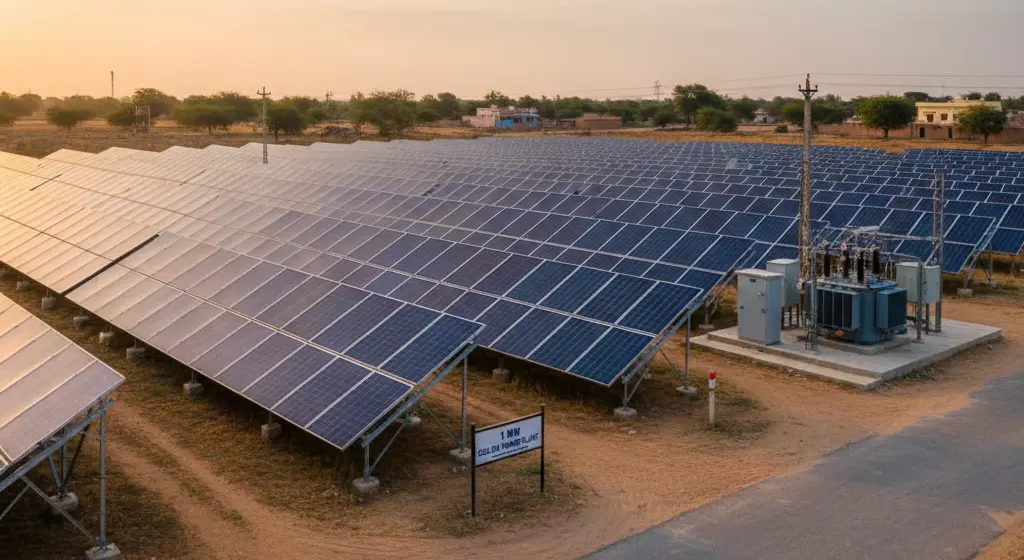
1 Megawatt Solar Power Plant Farm Total Cost: Detailed Breakdown
Here’s where the money actually goes:
| Component | Approx Cost (₹) |
|---|---|
| Solar panels | 1.8 – 2.2 crore |
| Inverters | 25 – 35 lakh |
| Mounting structures | 35 – 50 lakh |
| DC & AC cables | 20 – 30 lakh |
| Transformers & switchgear | 25 – 40 lakh |
| Civil & installation work | 20 – 30 lakh |
| Land development & fencing | 10 – 25 lakh |
| Engineering, approvals & misc | 10 – 20 lakh |
Panels alone account for nearly 40–45% of total project cost.
How Much Land for 1 MW Solar Plant?
Land requirement is one of the most searched and misunderstood aspects.
Standard Land Requirement
- 4 to 5 acres per MW (ground mounted)
This depends on:
- Panel wattage
- Tilt angle
- Inter row spacing
- Maintenance access roads
Why It’s Not Exactly “4 Acres Fixed”
Higher wattage panels reduce panel count but spacing remains governed by shadow rules, not panel size.
Flat land with minimal grading is always cheaper than uneven terrain.
How Many Panels Are in 1 MW?
The number of panels depends entirely on panel wattage.
Common Configurations
| Panel Rating | Panels per MW |
|---|---|
| 330 W | ~3,030 panels |
| 370 W | ~2,700 panels |
| 400 W | ~2,500 panels |
| 440 W | ~2,270 panels |
| 550 W | ~1,820 panels |
So, when people ask “how many panels are in 1 MW?”, the realistic answer is:
Between 1,800 and 3,000 panels
Modern utility projects increasingly use 540–600 W panels to reduce structure and wiring costs.
How Much Does a 1 MW Solar Plant Generate per Day?
Power generation depends on solar irradiation, not just plant size.
Average Indian Conditions
- 1 MW generates 4,000–4,500 units (kWh) per day
- Monthly: 1.2–1.35 lakh units
- Annual: 14–16 lakh units
Regional Variation
- Rajasthan, Gujarat: Higher end
- Eastern & coastal regions: Slightly lower
These figures are consistent with MNRE’s average CUF (Capacity Utilization Factor) of 17–19% for utility-scale plants.
Revenue Potential: What Does 1 MW Actually Earn?
Revenue depends on PPA tariff or captive usage value.
Typical Grid Tariffs
- ₹2.5 to ₹3.5 per unit (state dependent)
Annual Revenue Estimate
- ₹35 lakh to ₹55 lakh per year
O&M Costs
- ₹5–7 lakh annually
Net annual income: ₹30–48 lakh (before financing costs)
1 Megawatt Solar Power Plant Cost: Government Subsidy Reality
This is where expectations and reality often clash.
Is There a Government Subsidy for 1 MW Solar Plants?
Short answer: No, not directly.
- MNRE subsidies are primarily for rooftop solar
- Utility scale plants operate via:
- Competitive bidding
- State or central PPAs
- Renewable Purchase Obligations (RPOs)
What Support Does Exist?
- Land leasing by state governments
- Waived or reduced transmission charges
- Banking and open access benefits (state specific)
So while there is policy support, there is no flat cash subsidy for a 1 MW solar farm.
What Is the Cost of 2 MW Solar Plant in India?
A 2 MW plant is not double the cost of a 1 MW plant thanks to economies of scale.
Typical Cost
- ₹7.2 crore to ₹9.5 crore
Why It’s Cheaper per MW
- Shared transformers and evacuation
- Bulk panel procurement
- Lower per MW civil costs
This is why developers often prefer 2 MW or larger projects when land and capital allow.
Grid-Connected vs Captive 1 MW Solar Plant
Grid Connected (IPP Model)
- Power sold to DISCOM
- Fixed tariff, long term PPA
- Lower risk, stable income
Captive / Group Captive
- Power used by industry
- Savings based on industrial tariff (₹6–10/unit)
- Higher returns but regulatory complexity
Many industrial players prefer captive plants for energy cost control, not power trading.
Financing a 1 MW Solar Power Plant
Most projects are debt funded.
Typical Structure
- 70% loan
- 30% equity
Loan Tenure
- 10–15 years
Interest Rates
- 9–11% (depending on lender and risk profile)
Banks treat solar as a mature infrastructure sector now not a risky experiment.
Payback Period for a 1 MW Solar Plant
- 5–7 years (grid-tied with PPA)
- 4–6 years (captive usage replacing high cost power)
After payback, the plant generates near free electricity for 15–20 more years.
What Happens After 25 Years?
Solar plants do not stop working suddenly.
- Panels retain ~80–85% efficiency
- Inverters may need replacement once
- Structures last decades
Many plants continue operating beyond warranty periods with reduced output.
Common Myths About 1 MW Solar Power Plants
❌ “1 MW means 1,000 units per day”
No generation is 4–5× higher in India.
❌ “Government gives heavy subsidy”
Not for utility scale projects.
❌ “Maintenance is expensive”
Solar O&M is among the lowest of any power source.
Risks You Must Consider (Honestly)
- PPA payment delays (DISCOM risk)
- Policy changes at state level
- Land title clarity
- Grid evacuation availability
Solar is stable but not risk free. Due diligence matters.
Environmental & Long Term Value
A 1 MW solar plant:
- Offsets ~1,200–1,500 tons of CO₂ annually
- Reduces fossil fuel dependence
- Creates rural employment
This is why solar continues to receive strong policy backing.
Quick Summary: 1 Megawatt Solar Power Plant Cost in India
- Total cost: ₹3.8–5.2 crore
- Land needed: 4–5 acres
- Panels required: 1,800–3,000
- Daily generation: 4,000–4,500 units
- Govt subsidy: No direct subsidy
- Payback: 5–7 years
Final Thoughts: Is a 1 MW Solar Plant Worth It?
If you are looking for:
- Long term, asset backed returns
- Predictable cash flow
- Infrastructure level investment
Then yes a 1 megawatt solar power plant in India is a serious, mature opportunity.
It is not a shortcut to fast money. It is a 25 year infrastructure decision. Plan it well, structure it right, and solar will quietly work every single day long after the panels are paid for.










1 thought on “1 Megawatt Solar Power Plant Cost in India: Land, Generation, Panels, and Real Economics Explained”